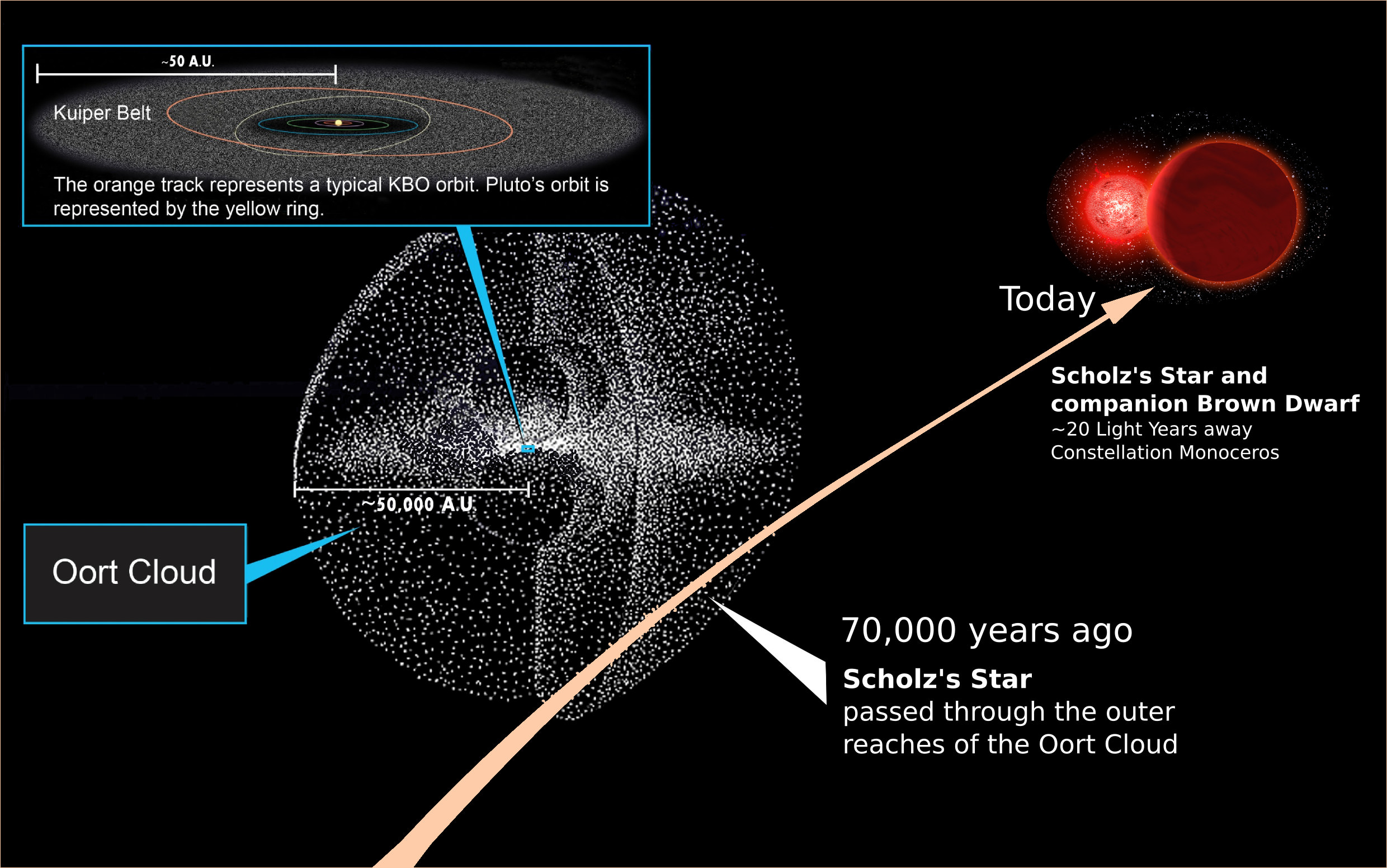
Currently Scholzs star is a small dim red dwarf in the constellation of Monoceros about 20 light years away. Did Scholzs star invade the Oort Cloud.

A Star Disturbed The Comets Of The Solar System 70 000 Years Ago New Evidence Of The Passage Of Scholz S Star Hubble Images Hubble Telescope Hubble Space Telescope
Scientists have determined that 70000 years ago binary system WISE J07200320-0846512 Scholzs Star passed within only 08 light-years of the Sun.

Scholz's star. It is magnetically active. But astronomers say theyve verified a flyby of this star 70000 years ago that dislodged comets from the Oort Cloud. Scholzs star is a M9 red-dwarf T5 brown-dwarf binary which made a very close 08 ly pass to the solar system some 70k years ago.
Scholzs Star is a nearby star which flew through the Solar Systems Oort cloud about 70000 years ago. About 70000 years ago during human occupation of the planet a small reddish star approached our solar system and gravitationally. It is in the southern constellation Monoceros near the Galactic planeThe primary is a red dwarf with 86 2 times the mass of.
At the moment Scholzs star is 22 light years away and appears at magnitude 183. Physical Realm Universe Astronomical Instrument Galaxy Milky Way Andromeda. Scholzs star is a red dwarf the smallest and faintest kind of star we know.
However at the closest point in its flyby of the solar system Scholzs star would have been a 10 th magnitude star about 50 times fainter than can normally be seen with the naked eye at night. To put its intrinsic faintness into perspective the Sun at that range would be mag 37. Red dwarfs are known periodically.
Best candidate for smartest aliens. Scholzs Star - posted in Scientific Amateur Astronomy. That is well inside the Oort belt.
Scholzs star W0720 is a low-mass object in the constellation Monoceros also tagged WISE J07200320-0846512 and only recently discovered by Ralf-Dieter Scholz in 2014 thanks to its dimness in optical wavelengths its proximity to the galactic plane and its low proper motion. This binary star system is now about 1723 light-years 5172 parsecs from the Sun. An exploration of past incidences where stars have passed close enough to the sun to penetrate the Oort cloud and a discussion of future encounters of this t.
Httpamznto2yJqwU6Hello and welcome to What Da MathIn this video we will talk about Scholz StarSupport this. It is a dim binary stellar system 22 light-years 68 parsecs from the Sun near the galactic plane in the constellation Monoceros. Scholzs Star is a M95T5 C star based on the spectral type that was recorded in Simbad at Strasbourg University.
Scholzs Star is a nearby star that passed through the Solar Systems Oort cloud approximately 70000 years ago. A red star system would have been a good candidate for harboring intelligent life. Still theres a chance the visitor made itself known.
Despite being so close its apparent magnitude is only 183 which shows how intrinsically faint it is. 2014 so it possible that Scholzs star may have occasionally been a naked eye object for minutes or hours during rare bright flare events. Based on the spectral type M95T5 C of the star the stars colour is red.
You can buy Universe Sandbox 2 game here. Scholzs Star is a Star type star. Scholzs star - named for its discoverer - is now 20 light-years away.
Scholzs Star had an unusual mix of characteristics. Scholzs star disturbed prehistory solar system comets. Scholzs Star Grazed Our Solar System 70000 Years Ago By Nola Taylor Redd 19 February 2015 An artists concept of Scholzs star with its.
It is also called WISE 0720-0846 more fully. As we mention in the paper Scholzs star is a magnetically active M95 star - similar stars have been seen to flare by more than 9 magnitudes Schmidt et al. Despite being fairly close only 20 light-years away it showed very slow tangential motion that is motion across the sky.
Even at its nearest point about 55000 astronomical units from our Sun 51 trillion miles Scholzs star would have been 100 times too dim to be seen with the naked eye. You can read the following links. Scholzs star dim binary star system consisting of a red dwarf and brown dwarf brown dwarf in astronomy celestial body that is larger than a planet but does not have sufficient mass to convert hydrogen into helium via nuclear fusion as stars do.
Deborah Byrd EarthSky How a Passing Star 70000 Years Ago Changed the Solar System Jay Bennett Popular Mechanics A Visiting Star Jostled Our Solar System 70000 Years Ago George Dvorsky Gizmodo Related. At a time when modern humans were beginning to leave Africa and the Neanderthals were living on our planet Scholzs star approached less than a light-year. Scholzs Star is not part of the Monoceros constellation outline but is within the borders of the constellation.
The radial velocity measurements taken by Ivanov and collaborators however showed the star moving almost directly away from the Solar System at considerable. Scholzs star is a nondescript M9 red dwarf T5 brown dwarf binary discovered in 2013 and located 22 light years away in Monoceros. Scholzs star system is a red star system that passed us at a distance of 08 light years away 54000 AU.
A red star system. The Sun at the same distance would be a mag 37 star about as bright as η Leonis.

Close Call Scholz S Star Grazed Our Solar System 70 000 Years Ago Oort Cloud Binary Star Solar System

Alien Star Visited Our Solar System 70 000 Years Ago Oort Cloud Nasa Solar System Solar System Exploration

Early Humans Witnessed A Comet Scattering Stellar Encounter Our Solar System Solar System Oort Cloud

Pin By Nvb Remnant On Cosmic Scale Cosmic Google Home Mini Egg Shape

Give Up On Planet 9 Physicists Paradox Solving

I Was The Sun And The Kids Were My Planets The Boston Globe Super Earth Andromeda Galaxy Red Dwarf

Antimatter And Antiwaves Are Annihilated Before They Reach Our Instruments And Eyes So We See Antimatter As Dark Matter Dark Matter Cosmic Eyes

Termination Shock Heliopause Bow Shock Voyager Spacecraft Astronomy Space Exploration

Pulsar Star Google Search Neutron Star Theory Of Gravity Astronomy

Planet9 Is Unproven But It Is Known That Scholz Star A Binary Red Dwarf And Brown Dwarf System Grazed The Outer Oortcl Oort Cloud Kuiper Belt Red Dwarf

Pin By Tracy Adams On Subject Ssf Space Facts Astronomy Facts Cool Science Facts
Solar System Our Solar System Binary Star

Influence Of Scholz S Star Seen 70 000 Years After Its Close Encounter Space Facts Comets And Asteroids Close Encounters

The Oort Cloud Is A Theorised Shell Of Icy Objects That Lie Beyond The Kuiper Belt As Such The Facts Detailed On Th Oort Cloud Space Facts Space And Astronomy
Pin By Tainara Arribard On Astronomy Oort Cloud Solar System Our Solar System

Astronomy Space And Astronomy Matter Science Astronomy

Scholz Star Comets And Asteroids Our Solar System Solar System

Comet Gateway Discovered To Inner Solar System Neptune Orbit Solar System Solar

Pin On Infographics
